Popcorn Science Experiment for Kids: Why Does Popcorn Pop?
Any teacher will tell you that engaged kids learn so much more than kids who are just listening. If a lesson is interactive, hands-on, or sensory, it draws kids in, and they keep what they learned long after the lesson is over. What better way to engage kids than snacky science? This popcorn science experiment kicks off our snacky science series, a set of lessons meant to pull kids into some really cool science by appealing to all the senses. Touch, taste, smell, sight, sound: snacks really hit all of them.
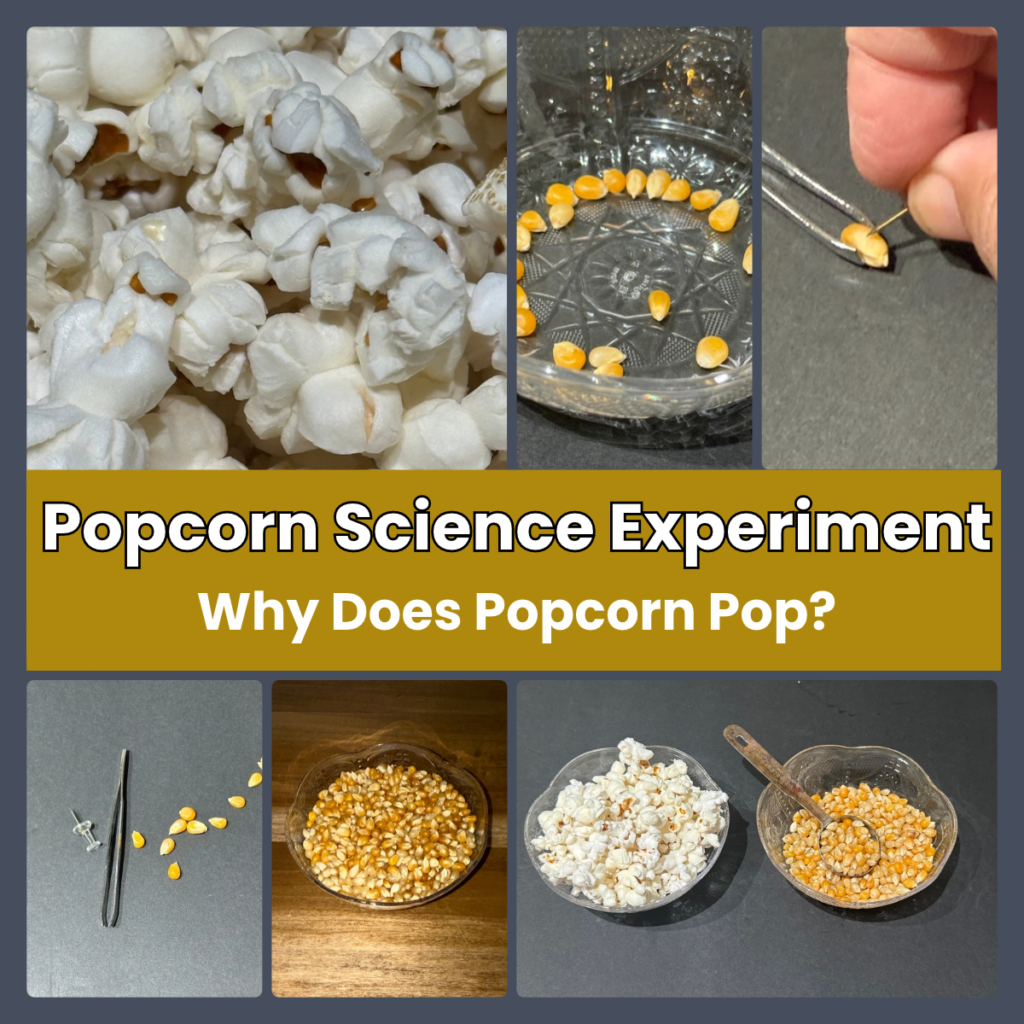
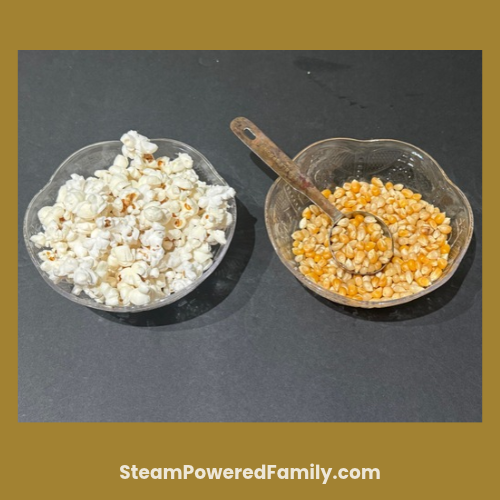
I think we can all agree that popcorn is a delicious snack. You can dress it up any way you want (sweet, salty, buttery, cheesy), and it’s yummy goodness that appeals to all ages. I don’t think there is a kid out there who wouldn’t recognize popcorn, but have they ever thought about why popcorn pops? In this edible science lab, kids learn what popcorn is and how and why it pops, then run a fair test comparing whole kernels with pierced ones, count popped vs. unpopped kernels, and record the results on a free printable sheet. Along the way we get to explore heat, states of matter, and pressure.
Why Does Popcorn Pop? The Science Explained
Table of Contents
Disclaimer: This article may contain commission, paid partnerships, or affiliate links. We independently review everything we recommend. When you buy through our links, we may earn a commission from qualifying purchases.
Popcorn pops because each kernel holds a small amount of water, about 14% of its weight, sealed inside a hard outer hull. When the kernel is heated, that water turns to steam and pressure builds until, at around 355°F (180°C), the hull bursts open. The softened starch inside puffs out into the white, fluffy foam we eat.
The Parts of a Popcorn Kernel
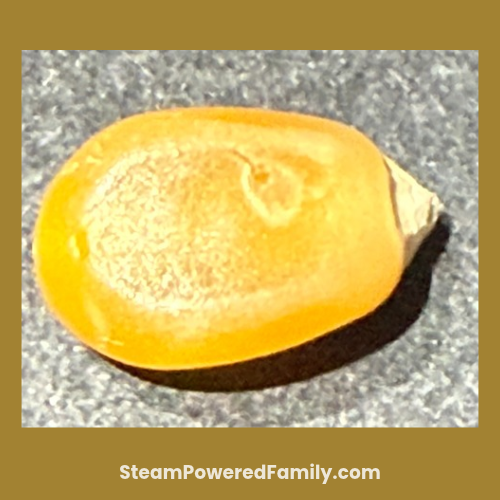
To really understand why popcorn pops, we need to look at a single popcorn kernel for the secret. Popcorn is different structurally than the yellow sweet corn the kids are probably used to eating at home. Its outer shell is thicker and much more watertight, and the starch inside is packed tightly. Popcorn kernels have three main parts:
- The Pericarp (Hull): This is the hard, moisture-resistant outer shell surrounding the kernel.
- The Endosperm (Starch): A dense, starchy interior inside the hull. This is where most of the water is held.
- The Germ: This is the part of the kernel that can develop into a new corn plant.
NOTE: Popcorn kernels contain about 13 to 14% moisture by weight, and that water is the key to the popping process.
How Steam Builds Pressure Inside the Kernel
Ask the kids: what happens when we heat water on the stove? This will start a discussion about bubbling and steam. When water is heated enough, it turns into a gas (the steam). So, when you heat the kernel, the water trapped in the starchy center heats up and turns into steam. Because the hard pericarp (hull) is sealed around the starch and water, the steam has nowhere to go. (Think about that boiling pot and the steam rising up and out.) Inside the kernel, the pressure builds and builds while the heat softens the starch into a gooey, gel-like mass.
By the time the inside of the kernel reaches about 355°F (180°C), the pressure can reach around 135 psi! PSI is pounds per square inch. It is a measurement of pressure, not how much something weighs. If you want to think about it, a car tire only has around 35 psi, so the pressure in the kernel is almost 4 times more! When the hull can no longer hold the pressure, it bursts open in a tiny explosion. The softened starch rapidly expands into a fluffy foam that sets almost instantly as it cools, creating the white, fluffy shape we love to eat. Hence the name POPCORN.
Popcorn Experiment Safety
This activity involves stovetop heat, hot oil, or microwave heat. An adult must handle all cooking, heat sources, and pins or needles.
- Hot oil and steam: Kids should watch from a safe distance. When you lift the lid or open a microwave bowl or bag, tilt it away from your face so the trapped steam doesn’t burn anyone.
- Hot kernels: Unpopped kernels and fresh popcorn stay hot for a few minutes. Let everything cool before kids sort and count.
- Choking hazard: Popcorn, popped and unpopped, is a choking hazard for children under 4, and they should not eat it. Elementary-aged children should be watched while enjoying their snacky science treat, and nobody should eat the hard unpopped kernels.
Who This Popcorn Experiment Is For
Kitchen-based science experiments are one of the most effective ways that I have found to foster a love of STEAM learning in kids. There is something about being able to touch, observe, measure, then eat their science experiments that can really drive home concepts like gas expansion, physical changes, and scientific variables!
This popcorn experiment for kids is designed for elementary students ages 6 to 12. Whether you are a homeschooler looking for an engaging afternoon lab or a classroom teacher introducing the scientific method, this activity brings together real-world inquiry with a fun sensory reward. Plan on about 45 minutes, including counting and discussion.
Popcorn Science Experiment Supplies
What you will need to complete this lab:
- Unpopped popcorn kernels (standard yellow or white popcorn)
- Cooking oil (vegetable, canola, or coconut oil)
- A pot with a clear glass lid (for stovetop viewing)
- Pushpins or needles (for piercing hulls; adult only)
- Tweezers or needle-nose pliers to hold the kernel while you pierce it
- A cutting board to pierce the kernels on
- A timer
- Measuring spoons and measuring cups
- Bowls or paper plates for sorting and counting
- Free Printable Popcorn Science Recording Sheet
How to Do the Popcorn Science Experiment
Follow these steps for a structured, fair-test experiment:
Step 1: Ask a Question and Make a Prediction
As with all scientific inquiry, we are going to start by asking a scientific question. In our case we have two questions:
What makes a kernel pop? What happens if the outer hull is damaged?
Have kids record their predictions for each question on their lab sheet before starting.
Step 2: Set Up a Fair Test
In a fair test, you change only one variable at a time while keeping everything else identical. We will have a control group and a test group of kernels, both from the same bag.
- Control Group: Count out 20 unaltered, intact popcorn kernels.
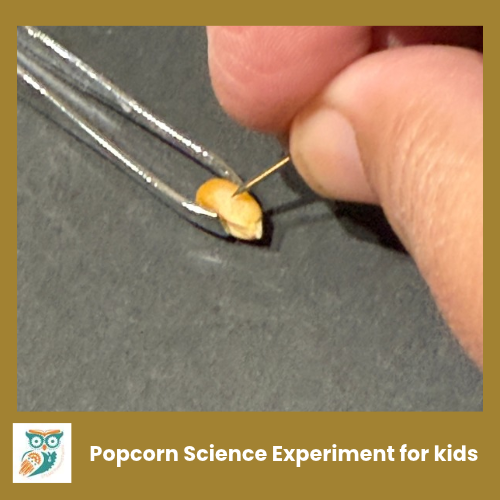
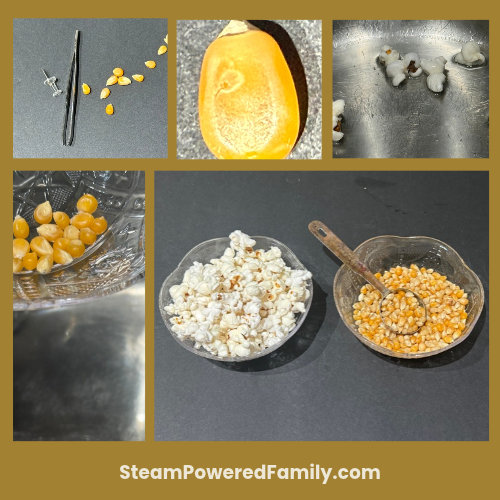
- Test Group (Pierced Hulls): Have an adult carefully poke a small pinhole into the outer hull of 20 popcorn kernels. Set each kernel on the cutting board, hold it with tweezers or pliers, and press the pin in firmly. Kernels are hard and can slip, so take it slowly. The hole only needs to go through the shiny outer hull. This breaks the sealed pericarp.
Step 3: Pop and Count (Adults Pop, Kids Observe)
- With adult assistance, heat 1 tablespoon of oil in the pot over medium heat for about 2 minutes, until it shimmers.
- Add the 20 control kernels, cover with the lid, and start the timer. Heat until the popping slows to about 2 to 3 seconds between pops, and write down how long that took.
- Remove the pot from the heat. Let the popcorn cool before counting how many kernels popped and how many remained unpopped.
- Wipe out the pot and let it cool down (or use a second, identical pot) so the second batch starts at the same temperature. Repeat with the 20 pierced kernels, using a fresh tablespoon of oil, the same heat setting, and the same cooking time as the control batch. Pierced kernels may barely pop, so the timer, not the popping sound, tells you when to stop.
Step 4: Record and Compare Results
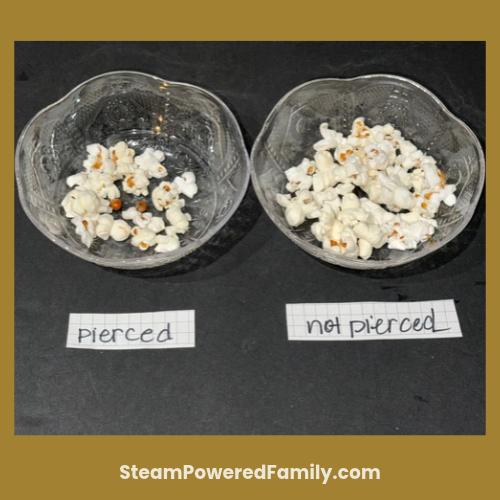
Compare the two sets of results side by side! Did the pierced kernels pop as often as the intact kernels? Were the popped pieces the same size and shape? Have kids record their observations and discuss why the results might differ. You can explain that a damaged hull lets steam leak out, so pressure can’t build up enough for the kernel to burst. Most pierced kernels won’t pop at all, or will only puff up a little, though a few might still pop if the hole is tiny.
To turn the counts into a bit of math, kids can figure out the percentage that popped in each group. With 20 kernels, every kernel counts as 5%, so 18 popped kernels would mean 90% popped.
Popcorn Experiment Variations to Try
Once you’ve tested pierced hulls, you can expand your lab with some fun testing variables. Remember to change only one thing at a time. Any of these would also make a great elementary science fair project.
- Compare Popcorn Brands: Test generic value brands against premium brands to compare popping ratios (popped vs. unpopped “old maids”). Use the same number of kernels for each brand, about 50 works well, and pop them all the same way.
- Regular vs. Oven-Dried Kernels: Bake a batch of kernels on a baking sheet at low heat (200°F) for about 90 minutes to dry out some of their internal water, let them cool completely, then pop them alongside regular kernels from the same bag. Kids can predict whether drier kernels will leave more old maids.
- Compare Heat Sources: Test stovetop in oil vs. a hot air popper vs. the microwave, and then look at the results side by side. Use plain kernels for each method (pre-flavored microwave bags add another variable) and the same counted number of kernels. For the microwave, pop plain kernels in a folded brown paper bag or a covered microwave-safe bowl. Air poppers can blow unpopped kernels out of the chute, so catch everything in a large bowl, and check your popper’s manual for the minimum amount it needs.
- Volume Expansion Measurement: Measure 2 tablespoons of unpopped kernels, pop them, then measure the total volume of popcorn with a large measuring cup (pour it in gently, don’t pack it down). To find the expansion ratio, convert to the same unit and divide. For example, if 2 tablespoons of kernels made 4 cups of popcorn, that’s 64 tablespoons, so the popcorn is 32 times bigger!
Free Printable Popcorn Science Recording Sheet
To make this lab turnkey and low prep, we have put together a lab recording sheet and lesson extras just for you! It includes a prediction page, a data table, and a bar graph for popped vs. unpopped kernels. All you need to do is add your email below to join our mailing list and get access to this Popcorn Lab and other great resources!
Popcorn Science Experiment FAQs
Kernels that fail to pop (often called “old maids”) usually don’t pop for two reasons: either the kernel was too dry (lacking sufficient moisture inside), or the outer hull had a tiny crack that allowed steam to escape before pressure could build. Kernels that dry out from being stored open in the pantry pop poorly, so keep popcorn in an airtight container. A few kernels may also simply not get hot enough if they sit off to the side of the pan.
Popcorn pops when the inside of the kernel reaches roughly 355°F (180°C), creating around 135 pounds per square inch (psi) of internal pressure. The oil in the pan needs to be hotter than that to heat the kernels quickly, which is why an adult should always handle the stove. If the oil starts smoking, the heat is too high.
Popping popcorn is mainly a physical change. The water inside the kernel changes from a liquid to a gas, a change in the state of matter, and the softened starch expands into a fluffy foam without becoming a new substance. You can’t turn popcorn back into a kernel, though, which makes it a great example for kids that not every physical change is reversible. If the popcorn scorches and turns brown, that browning is a chemical change.
Not really. Sweet corn and field corn kernels have thinner, more porous hulls, so the steam leaks out instead of building up pressure. They may toast, puff slightly, or burn, but they won’t burst into fluffy popcorn. If you have dried sweet corn on hand, it makes an interesting extra comparison group for your popcorn science experiment.
There are two main popcorn shapes. “Butterfly” (or “snowflake”) popcorn has irregular wings sticking out in different directions and is the kind most often sold for home popping and movie theaters. “Mushroom” popcorn pops into a round, sturdy ball, which is why it’s used for caramel corn and other coated popcorn. Have kids sort their popped kernels by shape and see which kind their brand makes most.
More Snacky Science and Kitchen Science to Try
If you’ve been looking for easy, edible science experiments that turn snack time into a memorable learning lab, this popcorn STEM activity is a great place to start! While you enjoy your science snacks, you can use popcorn to illustrate density and volume. Actually, you can use the lab as a jumping-off point for math, science, history, descriptive writing, and so much more. When you’re ready for more, browse our easy science experiments for kids, or try one of these other kitchen science labs on STEAM Powered Family:
- Kitchen Science For Kids: Rock Candy
- Candy Geode Kitchen Science
- Lava Toffee: When Kitchen and Science Collide
- Best Science Experiments at Home
Did your pierced kernels pop at all? Share your results in the comments below. We’d love to hear what your young scientists discovered!