

What Are the 3 States of Matter? Easy Introduction to Gas with the Balloon Inflation Lab
Everywhere you look, everything around you is made up of matter. It’s the ground beneath our feet (solid), the water that we drink (liquid) and the air we breathe (gas). While the first two states of matter are pretty easy to picture, the third is a little harder to wrap your head around – so we’re going to conduct a little lab experiment to bring invisible gas into focus for little minds.
So what are the three states of matter? Liquid, solid and gas – we all learn what the states of matter are when we’re in elementary school. How are solids, liquids, and gases different?
We know that solids hold their shape and liquids flow to fill spaces like a cup or a lake, it will keep going the more water there is, but gas is everywhere and you can’t see it doing its thing. In this gas lab we’re going to see what happens when you capture gas – and we’re sure to captivate little minds in the process.
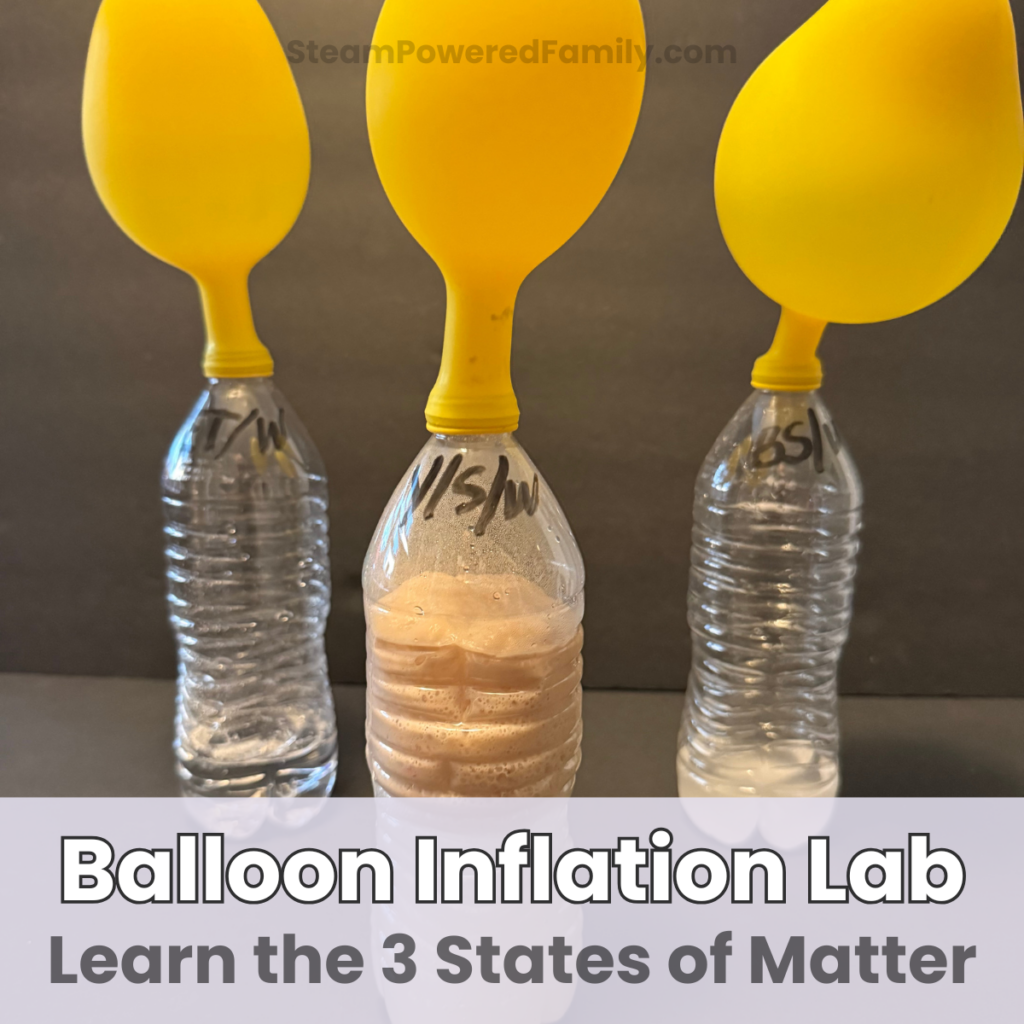
We are going to look at three different gas producing mixtures in this chemistry experiment for kids and take a look at which is the most powerful gas maker. Using three types of chemical reactions we want to see which produces the most carbon dioxide gas by seeing which can blow up a balloon the fastest and the biggest! We are going to use – baking soda and vinegar – yeast, sugar and warm water – and effervescent antacid tablets to compare reactions!
Disclaimer: This article may contain commission, paid partnerships, or affiliate links. We independently review everything we recommend. When you buy through our links, we may earn a commission from qualifying purchases.
What Are the 3 States of Matter?
Table of Contents
Matter exists in three states: solid, liquid, and gas, and each one behaves differently based on how its particles are arranged and how they move. Before we get to the balloons, it helps to understand what makes each state of matter distinct. Once kids have that foundation, the experiment becomes much more meaningful because they can connect what they are watching to the science behind it.
What Is a Solid?
A solid holds its own shape because its particles are packed tightly together and do not move freely. Think of a rock, a wooden block, or a piece of ice. You can pick it up, set it down, and it stays exactly the way it was. The particles inside are vibrating, but they are locked in place relative to each other, which is why solids keep their form without needing a container to hold them.
What Is a Liquid?
A liquid takes the shape of whatever container it is poured into because its particles can flow and slide past each other. Water is the classic example. Pour it into a cup and it forms a cup shape. Pour it into a bowl and it spreads out to fill the bowl. Liquid particles are close together, like solids, but they have enough freedom of movement to shift and flow. That is what gives liquids their pour-able quality.
What Is a Gas?
A gas spreads out to fill all available space because its particles move quickly and independently in every direction. Unlike solids and liquids, gases do not have a fixed shape or a fixed volume. They expand to fill whatever space they are in. That is exactly what you will see happening in this experiment: when gas is produced inside a bottle, it has nowhere to go but up, and it fills the balloon stretched over the opening.
What Do You Need for the Balloon Inflation Lab?
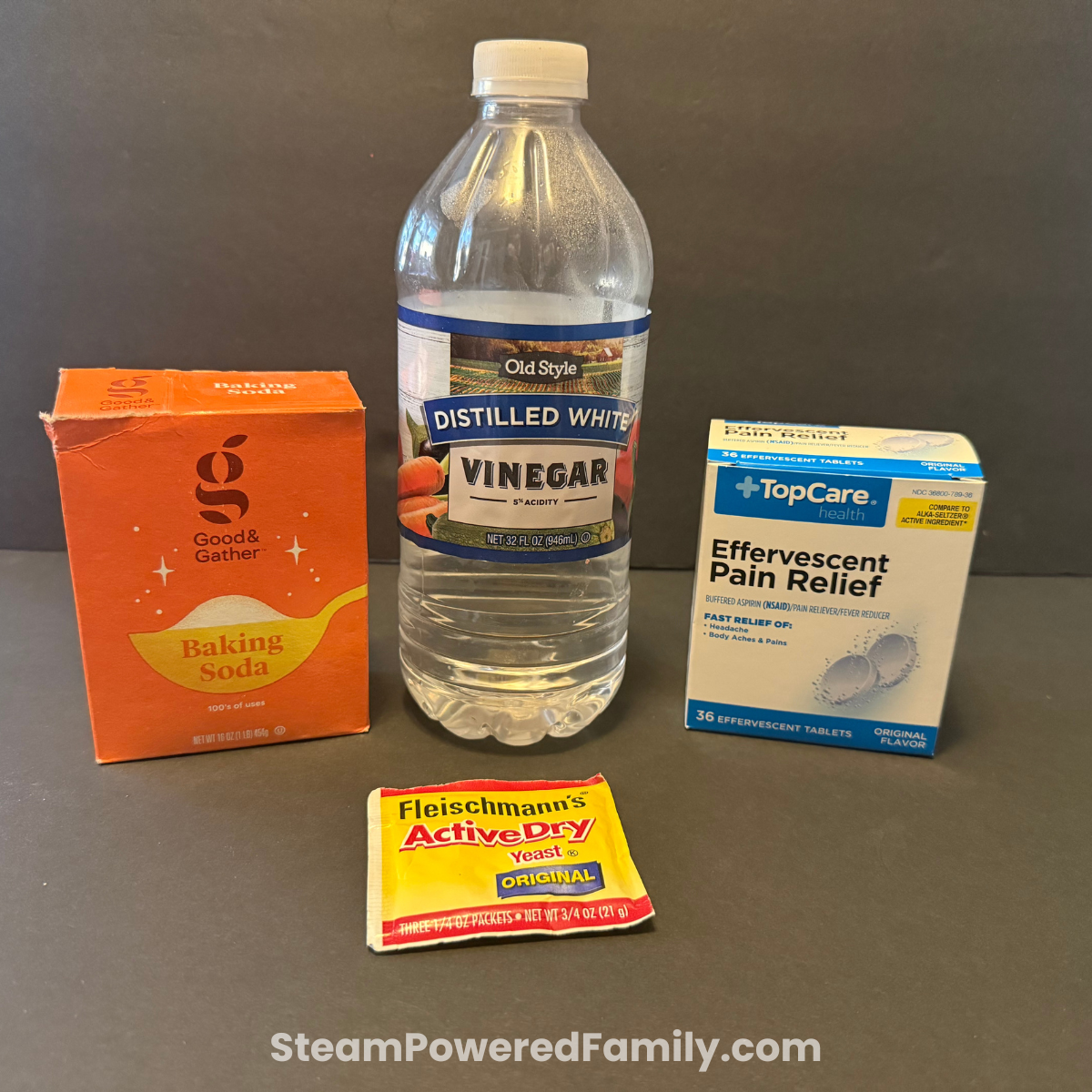
This experiment uses simple household ingredients you probably already have on hand. Gather everything before you start so the process runs smoothly, especially if you are doing this with younger kids who are excited and ready to go.
- Balloons (3, all the same size for a fair test)
- 3 empty plastic bottles (small, same size for a fair test)
- Baking soda
- White vinegar
- Active dry yeast
- Warm water
- Sugar
- Alka-Seltzer tablets
- Measuring spoons
- Funnel (optional but very helpful for getting the baking soda and yeast into the balloons)
A quick note on fairness: using the same size bottle and the same size balloon for each reaction is important. If you want results you can actually compare, the setup needs to be as consistent as possible. This is a great opportunity to talk with kids about what makes an experiment fair and controlled.
How Do You Set Up the Balloon Inflation Lab?
Setting up this experiment takes about ten minutes, and each reaction runs on its own once you stretch the balloon over the bottle. Run all three reactions as close together as possible so you can compare results in real time. Here is how to set up each one.
How Do You Make the Baking Soda and Vinegar Balloon?
This is the fastest of the three reactions and a great one to do first so kids can see gas production happen almost immediately.
- Pour about 4 tablespoons of white vinegar into the first plastic bottle.
- Use a funnel to add 1 teaspoon of baking soda into a balloon.
- Carefully stretch the opening of the balloon over the bottle mouth without letting the baking soda fall in yet.
- When you are ready, lift the balloon so the baking soda drops into the vinegar.
- Watch the reaction begin and observe the balloon as it inflates.
The baking soda and vinegar react almost instantly, so have your eyes ready. This one tends to get the biggest reaction out of kids because it happens so fast.
How Do You Make the Yeast Balloon?
The yeast reaction takes longer than the others, but it produces a steady, observable rise in the balloon as the yeast consumes the sugar, making it fascinating to watch over time.
- Pour about half a cup of warm water into the second bottle. The water should feel warm but not hot (around 110 degrees Fahrenheit is ideal).
- Add 1 teaspoon of active dry yeast and 1 teaspoon of sugar to the bottle.
- Give it a gentle swirl to combine.
- Stretch a balloon over the bottle opening right away.
- Set the bottle somewhere warm and observe over the next 15 to 30 minutes.
The balloon will inflate slowly and steadily as the yeast feeds on the sugar. This is a wonderful opportunity to talk about biological processes and how living organisms produce gas as a byproduct of their activity.
How Do You Make the Alka-Seltzer Balloon?
The Alka-Seltzer reaction is the simplest to set up because it only requires two ingredients and no mixing beforehand.
- Pour about 4 tablespoons of water into the third bottle.
- Break an Alka-Seltzer tablet into smaller pieces and place them inside a balloon using a funnel.
- Stretch the balloon over the bottle opening without dropping the tablet pieces in yet.
- When ready, lift the balloon to let the tablet fall into the water.
- Watch the fizzing reaction and observe how the balloon responds.
The Alka-Seltzer reaction is steady and very visual, with satisfying bubbling that kids can watch through the bottle walls as the balloon inflates above.
What Did You Observe?
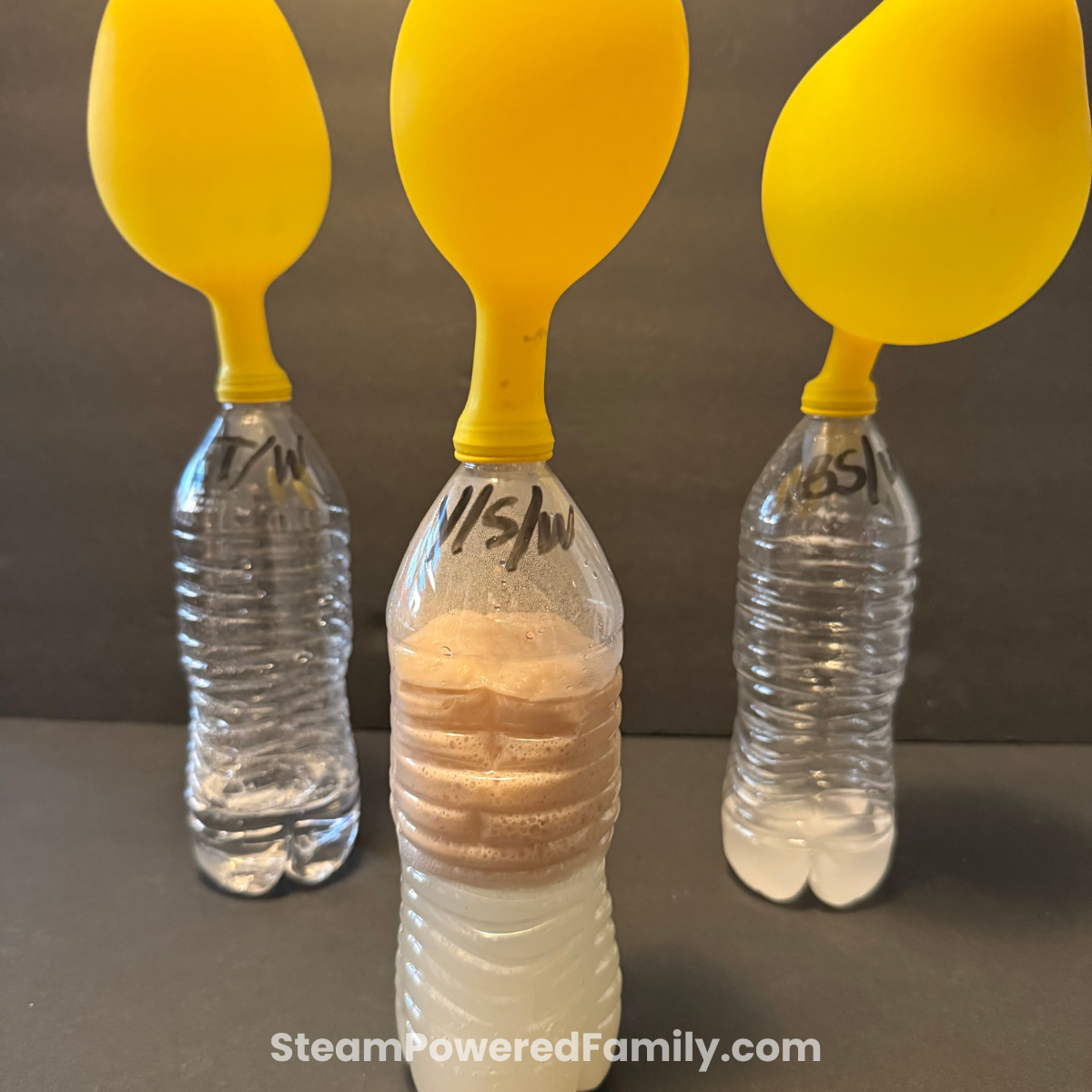
After running all three reactions, take a moment to compare your balloons before recording your results. This is where the real learning happens. Science is not just about doing an experiment; it is about slowing down to notice what actually occurred and asking good questions about it.
Work through these prompts together with your learner:
- Which balloon inflated the most?
- Which reaction produced gas the fastest?
- Did any reaction surprise you?
- What evidence showed that gas was being produced?
- Did the temperature of the water seem to affect how much gas was produced?
- How could you change the experiment to get different results?
Encourage kids to write down their observations or draw pictures of the three balloons showing the relative sizes. If you want to take this further, measure the circumference of each balloon with a piece of string and a ruler, then record the numbers. That data can be turned into a simple comparison chart or graph, which brings in a lovely math connection.
What Does This Experiment Teach About Gas?
All three reactions produce carbon dioxide gas, which is the same gas that makes bread rise and gives soda its bubbles. That connection alone tends to spark a lot of great questions from kids who suddenly realize they have been watching gas in action every time they open a fizzy drink.
Here is what is happening in each reaction:
Baking soda and vinegar is a chemical reaction. When an acid (vinegar) meets a base (baking soda), they react and produce carbon dioxide gas as a byproduct. The gas has nowhere to go but up, so it travels into the balloon and pushes it open.
Yeast and sugar is a biological process called fermentation. Yeast is a living organism, and when it consumes sugar, it releases carbon dioxide as a byproduct of that metabolic activity. This is exactly what happens inside a loaf of bread dough: the yeast eats the sugars in the flour, produces gas, and the dough rises. The balloon version just makes it visible in a much more dramatic way.
Alka-Seltzer and water is also a chemical reaction. Alka-Seltzer tablets contain citric acid and sodium bicarbonate (essentially the same base as baking soda). When they dissolve in water, the acid and base react and release carbon dioxide gas, which rises through the water, bubbles at the surface, and fills the balloon.
All three processes demonstrate the same core principle about the gas state of matter: gas particles spread out and exert pressure, and that pressure is exactly what pushes the balloon open. The gas is not pumped in; it is produced and it expands naturally to fill the available space.
This experiment also shows the difference between a chemical change and a biological process. Chemical changes happen when substances react to form something new. Biological processes happen because of the activity of living things. Both can produce gases, but the mechanisms are different, and that is a meaningful distinction worth exploring with older learners in the 9 to 12 age range.
What Are Some Extension Ideas?
If your learners are hungry for more after the main experiment, here are some ways to go further:
- Measure balloon circumference with string and create a comparison chart.
- Graph inflation results for each reaction.
- Test different amounts of ingredients to see how quantity affects gas production.
- Investigate how temperature affects the yeast reaction specifically.
- Explore carbon dioxide’s role in baking bread as a follow-up kitchen activity.
- Research other gases found in Earth’s atmosphere and discuss their roles.
- Create molecular model diagrams showing how particles are arranged differently in solids, liquids, and gases.
Frequently Asked Questions About the 3 States of Matter
Matter exists as solids, liquids, and gases.
A gas is a state of matter that spreads out to fill all available space.
Gas can be observed when it creates bubbles or inflates a balloon, making an otherwise invisible substance visible through its effects.
Yeast releases carbon dioxide gas as it consumes sugar in a biological process called fermentation.
Yeast releases carbon dioxide gas as it consumes sugar in a biological process called fermentation.
Alka-Seltzer creates carbon dioxide gas when it reacts with water, and that gas rises and fills the balloon.
Results vary depending on ingredients, temperature, and reaction time, which is part of what makes this a great comparison experiment.
It demonstrates how gases are produced through different reactions and shows that gases always occupy and fill available space.
More STEM Experiments for Kids
- Halloween Spider Light STEM Craft
- Back to School STEM Ice Breakers
- Melting vs. Dissolving Experiment: STEM Candy Lab
- Pipe Cleaner STEM Activities: The Ultimate No-Prep Classroom Tool