

Classroom Cardboard STEAM Art Projects
Did you know that something as simple as a pile of cardboard boxes could be used to teach? Kids have always loved to play with cardboard boxes. Turning boxes into forts, boats, cars, sleds, spaceships, dollhouses – you name it and a curious kid has probably created something with it!
Cardboard Creations – Creative Art Challenges
Table of Contents

Disclaimer: This article may contain commission, paid partnerships, or affiliate links. We independently review everything we recommend. When you buy through our links, we may earn a commission from qualifying purchases.
How to use a simple material like cardboard to build STEAM skills with kids!
I remember one Christmas when my son was maybe three or four my parents got him a gift and had packed it in a big box. He tore away the paper and shouted, “I got a box!” and ran and gave hugs. It was sweet and funny to see how he didn’t even realize there was more to the gift. He was thrilled with the box. We as parents and teachers can harness that love for building and creating and pair it with STEM concepts to show kids that the basis of STEM learning is really something they have loved all along!
Time to Create Some Cardboard STEAM Crafts
What do I need?
Obviously, the most important thing you will need is a big pile of cardboard. Everything from shipping boxes to cereal boxes, cardboard tubes and more. Get creative. Contact your local recycle center and see what they have available. They may have appliance boxes or carpet tubes, that all make fantastic building materials.

You will also need something to cut with. Scissors are obviously easily accessible, but a tool like the cardboard creator saw or electric scissors can be a great addition to this project to help build confidence with tools.
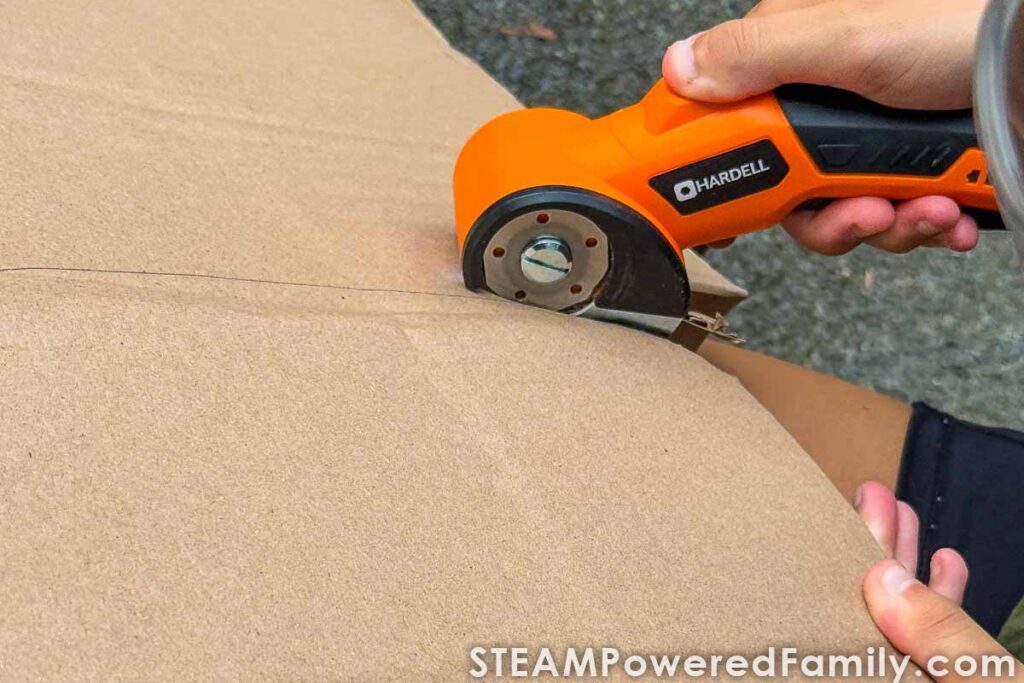
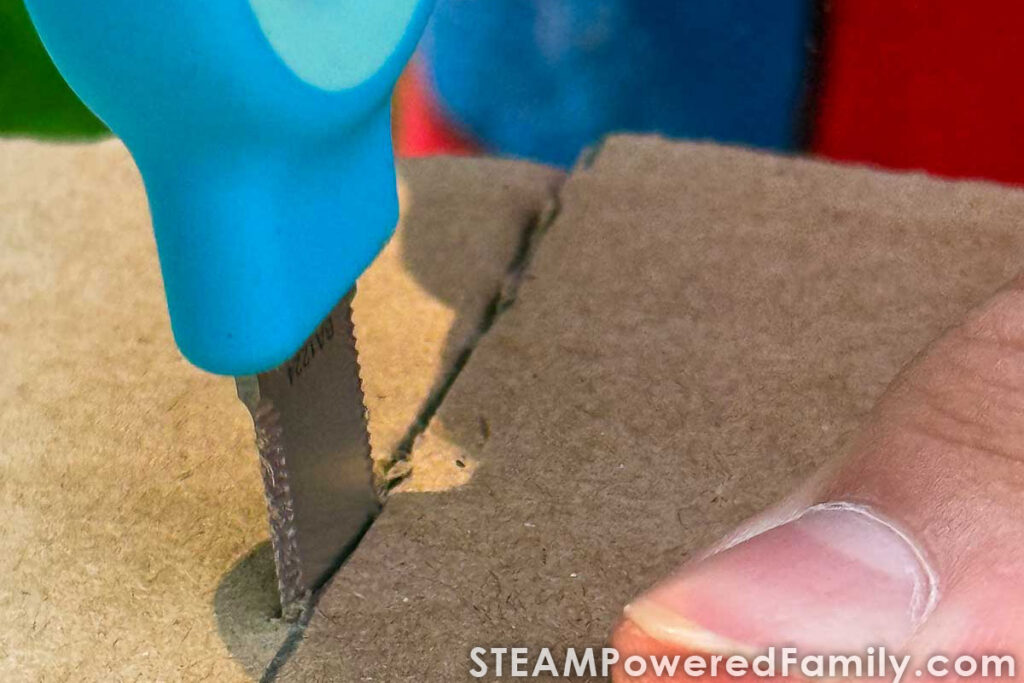
Safety Tip! Always, always know the skill set of the kids you’re working with – cutting bulky things like cardboard – even with safe cutting tools can lead to cuts and scrapes. If the kids are too young to cut safely you can have them draw out what they want cut and you or some older buddies can help cut safely.
Something to fasten and attach pieces together. You will want a variety of supplies for this so the students have options. We used masking tape, packing tape and a glue gun (really depends on the age you’re working with in your classroom).
Optional but fun: Things to decorate with like paints, markers, sparkles, paper, pipe cleaners etc. Plus, if your kids want to bring their creations to life, think out of the box, like skateboards, remote control cars, etc.
Using the Engineering Design Process in a Classroom Art Challenge
This STEAM Art project is the perfect way to teach the Engineering Design Process to students. When we create we need to ASK, IMAGINE, PLAN, CREATE and IMPROVE. This is the basis of the process so it will build understanding as the kids work. The best part about it in my eyes is that once you give them their “WHAT” they are free to make the decisions and use their imagination to complete the project. Sometimes less parameters mean more creativity. And you will be amazed at what they can create when giving free rein!
One Student’s Journey
For example: One of my students decided he wanted to make a person that could stand up out of a box because he thought it looked like a torso. So then he had to:
Ask:
What do I need to make this a person that can stand? Torso, Arms, Legs, Hands and Feet. How can I make this structure stand up without toppling? I need a solid foundation = good shoes!
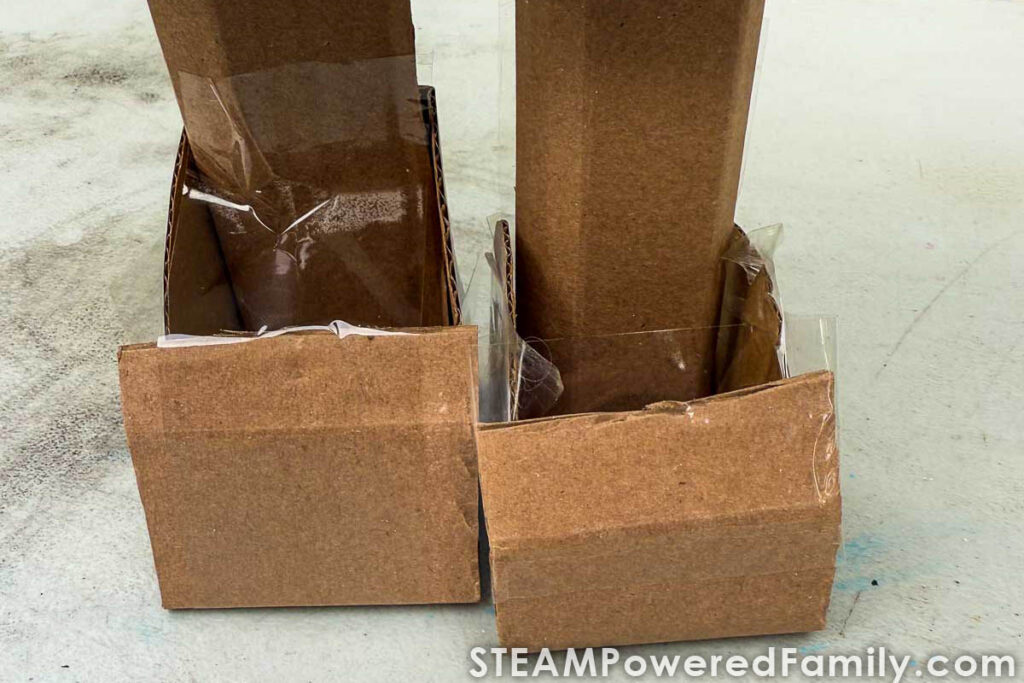
Using this initial questioning can spark curiosity and define problems that need to be addressed in the building process.
Imagine:
He sketched out the person with the head and neck and legs and shoes.
Plan:
He figured out what pieces he needed for the build and started thinking about shapes he would need. I suggested he think about measurements – he can’t have one leg 6 inches and one 10 – right? He also had to think about how he could use the inside of the torso box to build supports and hide the mechanics that were holding it together.

Create:
Start building. He worked piece by piece forming arms and legs and head and neck before removing on. Any student in the building stage will likely run into some roadblocks like something not working the way they envisioned, this is when we encourage the next step – problem solving and improvement.
Improve:
As he formed the arms and legs he realized that they wouldn’t hold the way he wanted – he used rolled up scraps of cardboard to make supports to steady it from within! The shoes were another place that he had to design, test, modify and test again. He really had to focus his efforts on center of gravity and balance to achieve what he had envisioned. It took a while but he accomplished what he set out to!

A Journey in Creativity, 3D and Details
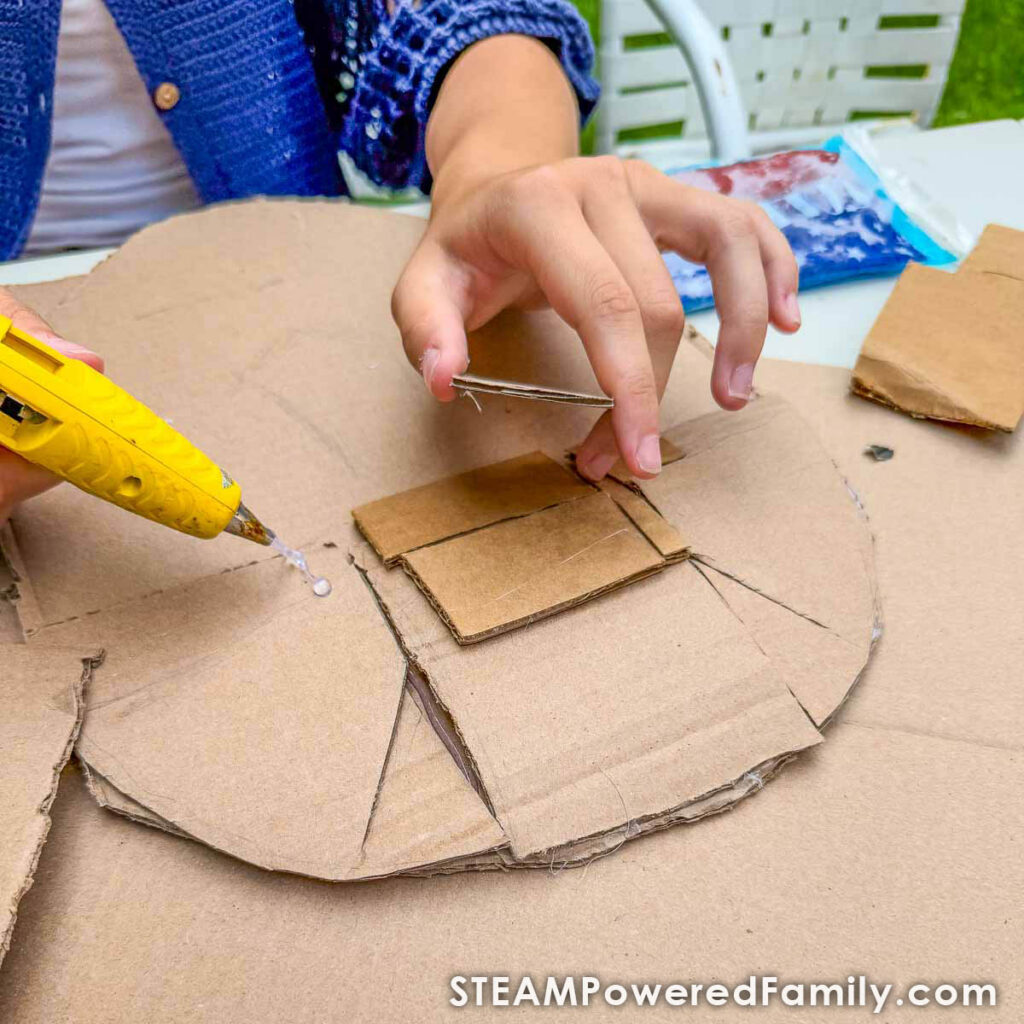
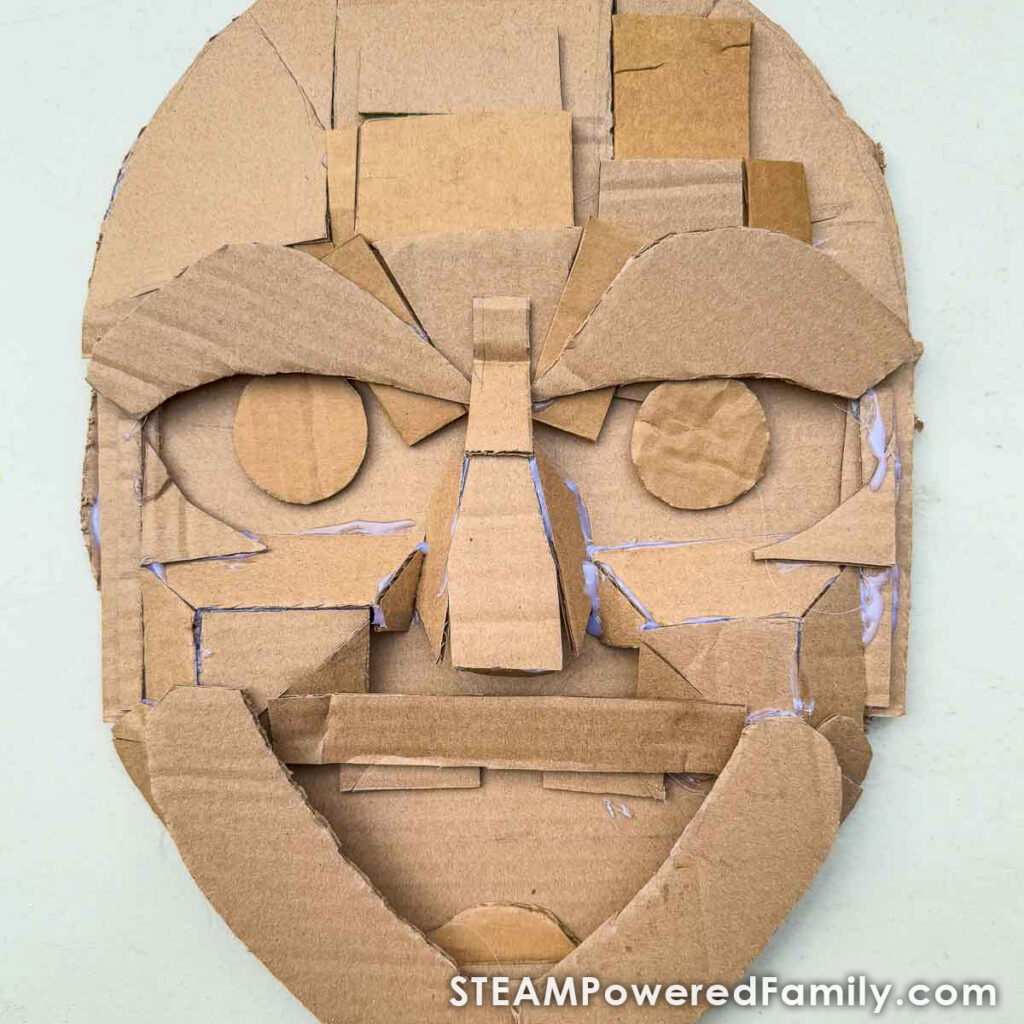
Another student decided to make a very detailed mask inspired by a favorite character. The detail that went into this project was incredible. They had to think about how to cut the pieces, and layer them in a specific order to create the 3D effect in the mask that they wanted. The result was a highly detailed mask.

STEM Art in Action
Every part of a cardboard build explores STEAM learning! How?
Science:
Kids have to do things like understand properties of materials – like – how strong is cardboard, what strength of tape or glue will hold my creation together. We see gravity in falling towers, we think about balance and mass and friction! So many science concepts can be tied to cardboard art.
Technology:
Technology isn’t just computers like kids might think – at its core technology is the tools we use to make things easier and work for us! Scissors, rulers, and tape dispensers are all simple technologies that help create masterpieces. Construction principles would also fall under technology – how to create joints and reinforce builds – that is technology in action! One student created a full on robot costume – climbed inside and used his hoverboard to move around and make the robot move – how’s that for incorporating technology!!
Engineering:
Someone building something – whether it’s a full scale robot or a 3-D representation of a face – kids being engineers, solving problems, finding solutions, and building. They use important concepts like structural integrity (strength and stability), load-bearing (how can I stack and distribute weight), and spatial reasoning (how can I use flat materials to form something with depth).
Math:
Every part of this is math – measurement in cutting their pieces, geometry in recognizing how shapes can bring their creation to life, how to turn a square to a cube, how much material they need!
Key Point! Ease and Affordability:
Cardboard is Affordable (Usually free) and Accessible (Check the recycle bin) Cardboard is really the dream material for STEM projects, especially for families and classrooms. This removes financial barriers, making hands-on learning accessible to everyone.
Adaptability:
Cardboard projects are absolutely adaptable to almost any age. The youngest learners can just use tapes boxes to stack and build like giant blocks (always work with the kids to keep them safe from toppling boxes). Young students focus on basic cutting, folding, and joining to create simple shapes and figures, like the box platypus. Older elementary kids can tackle more complex structures, thinking about balance and stability for a standing figure, a vehicle or a robot and older kids can explore how to create three-dimensional forms from flat sheets for a 3D face model, an animal profile or even cardboard mockups of houses or buildings. Cardboard really is an all around win for creating!
The Creativity with Cardboard
There were lots of fantastic creations made with cardboard. Here are a few more pictures.


More Cardboard STEAM Ideas
Create a Sweet Candy Dispenser
From a simple box platypus to a student sculpture of a face, to a full on Robot Costume, cardboard provides an accessible, engaging, and effective material for hands-on STEM education. It encourages creativity and problem-solving in real time. I guarantee if you try some of these projects you will never look at the recycling bin the same way again!