

Why Are Unit Fractions With Larger Denominators Smaller? (Why 1/8 Is Less Than 1/4)
If you ask a child which is bigger, 1/4 or 1/8, you might hear that 1/8 is bigger, because eight is bigger than four. So why are unit fractions with larger denominators smaller? It comes down to what that bottom number is really telling us, and kids can see it for themselves with a few hands-on models.
You can understand why they’d think that. Children spend years learning to count and compare whole numbers, and as whole numbers, eight really is bigger than four. Fractions ask them to look at those same numbers in a different way: we’re asking them to hold onto the idea of one whole, and then picture it broken into pieces that are each smaller than that whole.
There’s something else going on in that word “eight” that’s worth drawing kids’ attention to . . . When we add “th” to a whole number, we’re not just relabeling it, we’re moving it into a different number family. Eight tells you how many of something there are. Eighth tells you which equal piece of a whole you’re looking at, and how many equal pieces that whole was cut into in the first place. Eight and eighth look almost identical, but they’re answering two completely different questions. I point that out directly: this isn’t the number eight showing up again, it’s a new kind of number doing a new kind of job, because it’s part of a fraction now. Being explicit by showing the students how to write it and why goes a long way in them understanding it’s different and cueing them as they move forward.
Before children can compare fractions, they need to understand what we mean by one whole. That concept is very abstract and when we don’t build a concrete understanding, the idea can become one of the barriers to understanding fractions. That whole might be a pizza, a piece of paper, or a rectangle standing in for a yard of fabric. Whatever we choose, it helps to start with something children can see and hold.
Imagine taking one pizza and cutting it into four equal pieces. Each piece is one fourth of that pizza. The four tells us how many equal pieces make up the whole, and the one tells us we’re talking about one of those pieces.
Now imagine cutting another pizza, the exact same size, into eight equal pieces. Each piece is one eighth. We have more pieces, but we haven’t added any pizza. Each piece has to be smaller, because we’re sharing the same amount among more pieces.
That’s the idea children need time to understand: when the whole stays the same size, dividing it into more equal pieces makes each piece smaller. One fourth of a pizza is bigger than one eighth of that same pizza, even though eight, by itself, is bigger than four.
During my years in the classroom, I found that children could often tell me which number was the numerator and which was the denominator (there are tons of tricks for that . . . “n for north, numerator” or “d for down, denominator”), without fully understanding what either number was telling them. The bigger challenge was understanding the whole. What exactly are we dividing? How many equal pieces are we making? And what happens to the size of each piece when we divide that same whole into more parts?
Those are questions worth exploring before we ask children to remember a rule. With a simple sharing challenge, a few good questions, and a hands-on game, kids can discover the relationship for themselves rather than just memorizing it. That’s what this post, and our A Game of Fractions digital math game, are built to do.
Table of Contents
Table of Contents
- What a Unit Fraction Really Tells Us About the Denominator
- Why Kids Think a Bigger Denominator Means a Bigger Fraction
- Why Are Unit Fractions With Larger Denominators Smaller?
- Why This Matters for Later Fraction Skills
- Practice Naming Unit Fractions with the A Game of Fractions Game
- Grab the Printable Recording Page
- Try It Away from the Screen
- Where We Use Unit Fractions in Real Life
- What Comes Next: From Unit Fractions to Comparing Fractions
- Make Math Practice Feel Like Play!
- Frequently Asked Questions
What a Unit Fraction Really Tells Us About the Denominator
Disclaimer: This article may contain commission, paid partnerships, or affiliate links. We independently review everything we recommend. When you buy through our links, we may earn a commission from qualifying purchases.
A unit fraction is one equal part of a whole, like 1/2, 1/4 or 1/8. The numerator is always 1. When I introduced fractions to my students, I described them simply as one piece out of a certain number of equal pieces: 1/4 means one piece out of four equal pieces. I’d say it that way, with all of those words, many times before I’d let anyone just say “one-fourth.” It was always “one piece out of four.” And when I wrote it, I wrote it using the same language as I demonstrated: one piece (write the 1), out of (write the fraction bar), four pieces (write the 4).
That slow, repetitive start gave them something to refer back to. When they got stuck later, they could rebuild a fraction from scratch instead of guessing, because they actually understood what each part meant, not just what to call it.
The two numbers have different jobs. The denominator, on the bottom, tells us how many equal pieces the whole has been divided into. The numerator, on top, tells us how many of those pieces we’re talking about. In 1/8, the whole has been cut into eight equal pieces, and we’re talking about one of them.
But before any of that means much, children need to understand what we’re calling the whole. A whole might be a brownie pan, a strip of paper, a length of ribbon, or one inch on a ruler. It doesn’t have to be round, it doesn’t have to be something you can eat, and it doesn’t have to be a circle or rectangle on a page. What matters is that we know what we started with, and that we’re dividing it into equal parts.
Those parts have to be equal for the fraction to mean anything. If you cut a pan of brownies into one huge piece and five tiny ones, you can’t call any of them “1/6,” because they aren’t the same size.
Why Kids Think a Bigger Denominator Means a Bigger Fraction
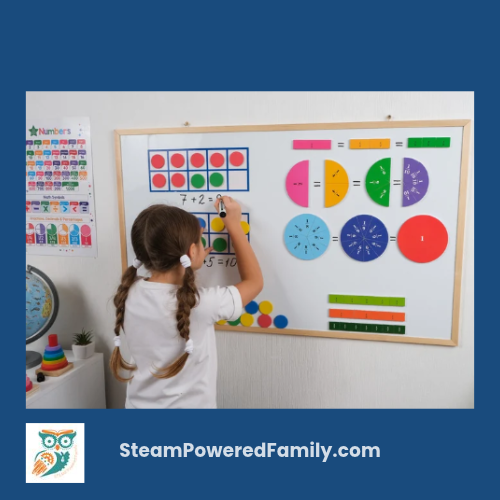
When a child says 1/8 is bigger than 1/4, they’re usually just applying something they already know about whole numbers: eight is greater than four, so why wouldn’t one-eighth be greater than one-fourth? The problem is that the denominator doesn’t tell us the size of a piece. It tells us how many equal pieces make up the whole.
A few other things tend to be tangled up in the same mix-up:
- Comparing pieces from different-size wholes: Half of a tiny brownie isn’t necessarily bigger than a fourth of a huge one. We have to start from the same amount if we want to compare the pieces fairly.
- Counting dividing lines instead of pieces: A rectangle with three interior lines has four pieces, not three, and that miscount throws off the whole comparison.
- Knowing the vocabulary without the meaning: A child might correctly name the denominator and still think it tells you how many pieces are shaded.
Rather than correcting every mistake with another explanation, I like to ask children to show me how they figured something out. Their explanation usually tells me exactly what needs clarifying, far better than another lecture would.
Why Are Unit Fractions With Larger Denominators Smaller?
Unit fractions with larger denominators are smaller because we’re dividing the same whole into more equal pieces. The more pieces we make, the smaller each one gets. For example, cut one pizza into 4 equal pieces and an identical pizza into 8, and each eighth is smaller than each fourth, even though 8 is bigger than 4.
This is much easier to understand when children have something they can divide, move and compare with their own hands, not just on paper.
See It With the Same-Size Whole
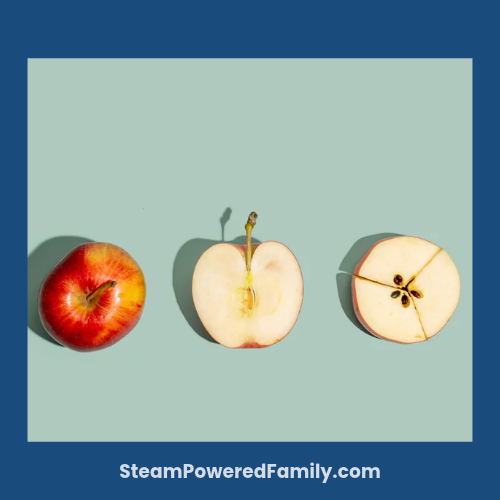
Line up three identical strips of paper, or three identical pizzas if you’d rather make it a snack. Cut one into 2 parts, one into 4, and one into 8. Lay a single piece from each cut side by side. The piece from the strip cut into 8 is clearly the smallest, even though 8 is the biggest number.
Try It With a Fair Share
With my own kids, and with my students, I’d give them a mission: how many people are sharing, and how many equal pieces do we need to cut the whole into? (I always made them use the real vocabulary here.) Then I’d ask who wanted to do the cutting, and once someone volunteered, I’d add the twist: everyone else gets to choose their piece before you do. You get whatever’s left. That one rule made kids incredibly precise about cutting equal pieces, whether it was a brownie pan at home or an activity at school, because nobody wants to end up with the smallest piece from their own cut.
The Simple Rule for Comparing Unit Fractions
When the numerators are both 1 and the wholes are the same size, the fraction with the bigger denominator is the smaller piece: 1/8 is less than 1/4, which we write as 1/8 < 1/4.
Quick Self-Check
Before answering a comparison question, I ask my students two things: are both pieces cut from the same-size whole, and which whole is cut into more pieces?
| Unit fraction | Equal parts in the whole | Piece size |
|---|---|---|
| 1/2 | 2 equal parts | Biggest pieces |
| 1/3 | 3 equal parts | Smaller than 1/2 |
| 1/4 | 4 equal parts | Smaller than 1/3 |
| 1/5 | 5 equal parts | Smaller than 1/4 |
| 1/6 | 6 equal parts | Smaller than 1/5 |
| 1/8 | 8 equal parts | Smaller than 1/6 |
| 1/12 | 12 equal parts | Smallest pieces in the game |
Why This Matters for Later Fraction Skills
This one idea underlies comparing and ordering fractions, placing them on a number line, and eventually finding equivalent fractions. A child who truly understands it can reason that 1/6 is bigger than 1/10 without drawing a single picture. A child still stuck in whole-number thinking will keep getting these comparisons backwards, no matter how many problems you hand them.
I saw this shift happen with one student who stayed confused even after a lot of practice, until we backed all the way up to a ruler.
I had her look at one inch and asked what she noticed about the marks, because 1, 1/2, 1/4, 1/8 and 1/16 are all easy to see and compare on a ruler. Once that made sense, we moved it to paper, drawing our own line, six inches long this time.
She wasn’t sure at first why we were drawing a line instead of cutting something, until I held up the ruler and said our whole was going to be “this long.” We marked the increments, added the measurements, and when she looked at the fractions in order from smallest to one whole, she stopped, stared for a second, and said, “Ohhh, I get it!”
That’s the moment this idea is really working: when a child can put fractions in order without needing to be told which one is bigger.
Practice Naming Unit Fractions with the A Game of Fractions Game
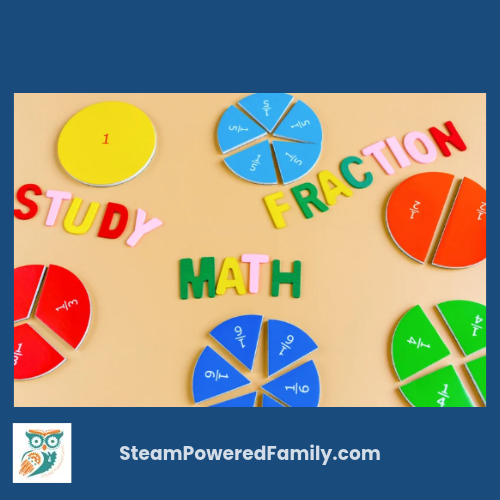
Our A Game of Fractions game from Digital Math Games gives kids 11 problems, no timer. Each one shows a fraction picture, a whole cut into equal parts with one part shaded, and the child taps the matching unit fraction from choices between 1/2 and 1/12 placed around the picture.
What I like about this game for this exact mix-up: the whole stays the same size across the problems while the number of parts changes, so kids can watch the pieces shrink as the denominator grows. While they play, ask: “Is this piece bigger or smaller than the last one?”
How to Play A Game of Fractions
- Press Start and read the “How to play” card.
- Count the equal parts in the picture.
- Tap the matching unit fraction.
- Press “Next problem.”
A wrong tap shows “Something needs another look,” and the child simply tries again. A correct tap shows “You worked it out!” Nothing is ever taken away.
Give Me a Hint
Three built-in hints, each a little more help than the last:
- Count how many equal parts the whole shape is cut into.
- Write the total parts on the bottom and the shaded parts on top.
- Count all the parts, shaded and unshaded, because that count is the denominator.
None of the hints hand over the answer. Each one points the child back to counting the equal parts, which is exactly the habit that fixes the “bigger number, bigger piece” mix-up.
What to Say When Your Child Says the Bigger Denominator Is Bigger
I try guiding questions instead of reteaching from scratch, and I ask my own students to show me how they got their answer before I say anything:
- “How many pieces is this cut into?”
- “If more people share the same pan of brownies, does each piece get bigger or smaller?”
- “Are we comparing pieces from the same-size whole?”
Grab the Printable Recording Page
The recording page has kids sketch fraction models, circles for 1/6 and 1/8, then their own models for 1/4 and 1/7, and write the unit fraction for each. It also has a fill-in-the-blank definition of numerator and denominator. After drawing 1/6 and 1/8, ask which slice is bigger, and why.
Try It Away from the Screen
- Fold paper strips into halves, fourths and eighths, and line them up.
- Cut identical sandwiches, or an identical pan of brownies, into different numbers of equal pieces.
- Break cheese sticks into equal parts, or break popsicle sticks into halves, thirds and quarters like the math practice in our no prep STEM with popsicle sticks activities.
Keep the whole the same size in every activity. That’s what makes the comparison fair, and it’s what makes the “aha” happen.
Where We Use Unit Fractions in Real Life
- Sharing food fairly among friends or siblings, with the entire item being the whole (whole watermelon, whole pan of brownies, whole pizza)
- Measuring cups in baking (1/4 cup versus 1/3 cup), with one cup being the whole
- Telling time (a quarter hour versus a half hour), with the hour being the whole
- Tools marked in fractions of an inch, like 1/8-inch versus 1/4-inch drill bits, with one inch being the whole
What Comes Next: From Unit Fractions to Comparing Fractions
Once kids understand unit fractions, they’re ready to compare fractions that aren’t unit fractions, starting with ones that share a numerator or a denominator. The “more parts means smaller parts” idea carries right over. The Comparing Fractions game inside Digital Math Games is a natural next step.
Make Math Practice Feel Like Play!
Digital Math Games turns practice like this into something kids actually want to do, with instant feedback and hints that build reasoning instead of just handing over the answer. For more ideas to try at home, browse our hands-on math activities.
Start your free 2-week trial and play A Game of Fractions
Common Core Learning Connection
This activity supports 3.NF.A.1 (understanding a unit fraction as one part of a whole cut into equal parts) and 3.NF.A.3d (comparing two fractions with the same numerator by reasoning about their size, and recognizing the comparison only works when both fractions refer to the same whole). It also builds the mathematical practices of reasoning abstractly and quantitatively and using appropriate tools strategically.
The Takeaway
The denominator tells you how many pieces there are, not how big they are. Once that clicks, “bigger number, smaller piece” stops being a trick and starts being obvious. Try the game together and watch it happen, and if your child enjoys it, our post on how to add angles without making it complicated uses the same hands-on approach.
Frequently Asked Questions
A unit fraction always has 1 as its numerator, so it names exactly one equal piece of the whole, like 1/3 or 1/8. A fraction like 3/8 names three of those pieces. Kids usually learn unit fractions first because every other fraction is built from them: 3/8 is just three 1/8 pieces put together.
Put the fraction with the largest denominator first, because it’s cut into the most pieces and has the smallest piece. For example, 1/12, 1/8, 1/6, 1/4, 1/2 is in order from least to greatest. This only works when every fraction refers to the same-size whole.
Usually 3rd grade. Standard 3.NF.A.1 introduces the unit fraction as one equal part of a whole, and 3.NF.A.3d asks kids to compare two fractions with the same numerator by reasoning about the size of the pieces.
Only when the numerators are the same and the wholes are the same size. Once numerators are different, this rule doesn’t apply on its own; for example, 3/8 is bigger than 1/4, because three eighths cover more than one fourth.
Draw two number lines from 0 to 1 that are exactly the same length. Divide each into the number of equal parts shown by its denominator, and compare where the first mark falls. The fraction whose first mark is closer to 0 is the smaller unit fraction.