

How to Add Angles Without Making It Complicated
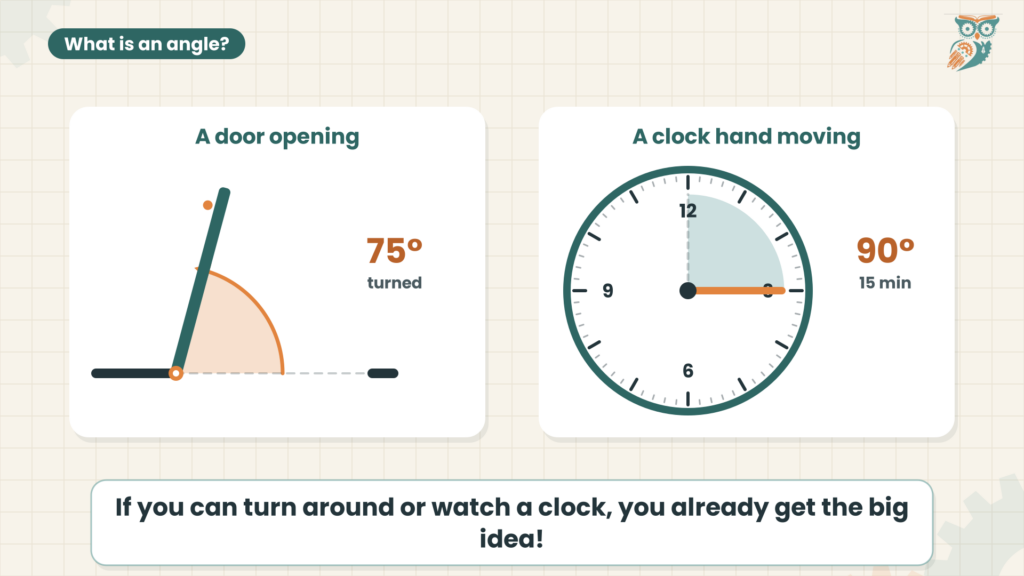
Think about opening a door. When it’s closed, it points in one direction. As you open it, the door rotates around its hinges, creating an angle between its starting position and its new position.
That’s one way to understand an angle: it measures the amount of rotation, or turn, between two directions. We measure that turn in degrees (°). The farther the door opens, the greater the angle.
Once children understand that angles measure how far something has turned, adding angles becomes much easier to visualize. If a door opens 30 degrees and then opens another 45 degrees, we can add those two measurements to find the total angle: 30° + 45° = 75°.
In this post, we’ll explore how to add angles using simple examples, hands-on activities, and our Add Angle Measurements Digital Math Game, which provides the problems, practice and immediate feedback for students.
Disclaimer: This article may contain commission, paid partnerships, or affiliate links. We independently review everything we recommend. When you buy through our links, we may earn a commission from qualifying purchases.
Think of Angles as Turns
Table of Contents
If angles have never felt especially clear to you, you are not alone. Many adults remember learning angle names and using a protractor, but not necessarily understanding what the numbers really meant. Over the years, I have found that angles make much more sense to children, and often to adults, when we stop treating them as diagrams to memorize and start thinking of them as turns.
Imagine standing in one place, facing straight ahead. Now turn your body to the right until you’re facing a different direction. You just made a turn!
In math, we can measure how far you rotated using an angle. If you turn one-quarter of the way around, you’ve turned 90 degrees. If you turn until you’re facing the opposite direction, you’ve made a 180-degree turn. Turn all the way around until you’re facing your original direction again, and you’ve completed a 360-degree turn.
How Does a Turn Become an Angle?
When we draw an angle on paper, we’re representing those starting and ending directions with two lines (or rays) that meet at a common point, called the vertex.
- The first ray represents the starting direction.
- The second ray represents the ending direction.
- The vertex is the point where the two rays meet, like the hinge of a door.
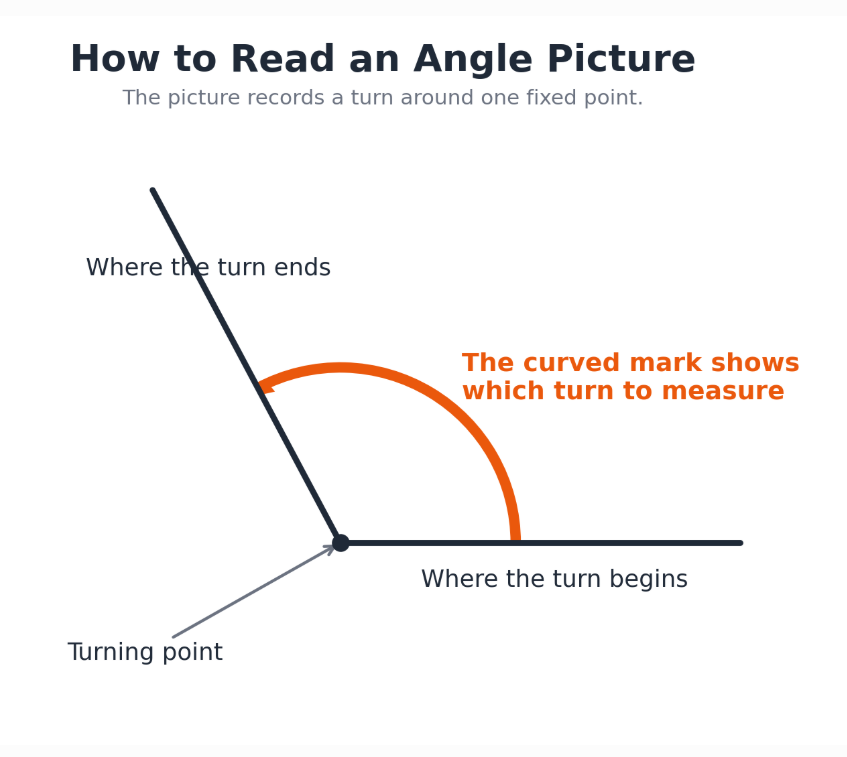
- The curved mark, called an arc, shows which angle we’re measuring.
The number of degrees tells us how much rotation there is between those two directions.
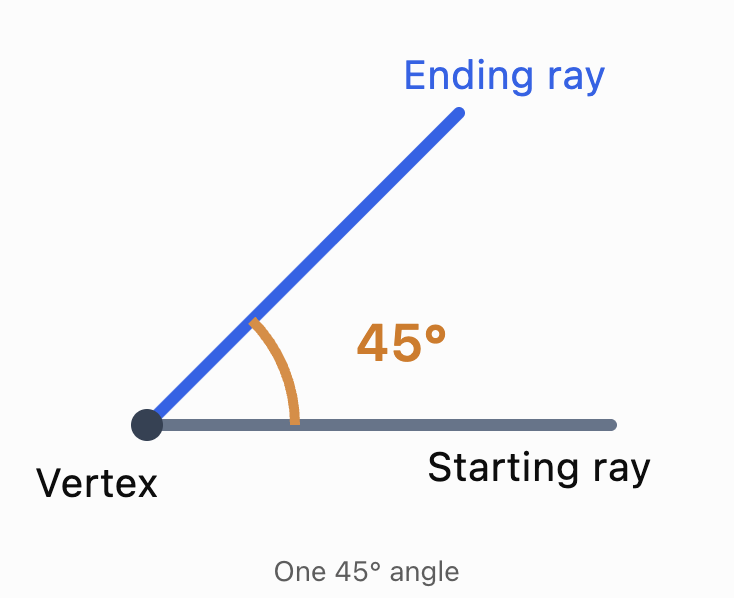
The angle isn’t determined by how long the lines are. It’s determined by how much one direction has rotated away from the other.
That’s why thinking about angles as turns can be so helpful. Instead of just looking at two lines on paper, children can imagine one line rotating away from the other.
When we look at the diagram of an angle it can sometimes feel more complicated to understand when its on paper. But, if we remember the thinking behind how this abstract concept is represented concretely, it’s pretty simple:
- The lines in an angle diagram simply show the starting and ending directions.
- The curved line, or arc, helps show which turn we are measuring.
Try Making the Turns
To bring this concept to life, try making a few turns together. Turn your body, move the hand of an analog clock or rotate one pencil while keeping its end touching another pencil. Angle measurements become much easier to understand when the numbers describe something you can actually move.
The chart below shows how to understand what the turns are telling us:
| Turn | Clock movement (minute hand) | What it looks like |
|---|---|---|
| 90° | 15 minutes around the clock | One-quarter turn |
| 180° | 30 minutes around the clock | Half turn |
| 270° | 45 minutes around the clock | Three-quarter turn |
| 360° | 60 minutes around the clock | Full turn |
Try It With Two Pencils
Place two pencils on a table with their eraser ends touching. Keep one pencil still and rotate the other to create different angles.
Start with a small angle, then rotate the moving pencil farther away. Notice how the angle gets larger even though the pencils haven’t changed length.
Now try making a 90-degree angle, like the corner of a square. Rotate the moving pencil another 45 degrees. You’ve created a 135-degree angle!
This is the same idea children will use when adding angles in the game: two smaller angle measurements can be combined to find a larger angle.
Play the Human Protractor Game
Get your child up and moving to help them experience angle addition with their whole body!
- Have your child stand in one spot, facing straight ahead. Place a piece of tape on the floor pointing in the direction they’re facing. This is their starting position.
- Ask them to make a quarter turn to the right (90 degrees). Have them point in their new direction.
- Now ask them to make another quarter turn to the right (90 more degrees).
- Ask: “How many degrees did you turn altogether?”
90° + 90° = 180°! They’ve made a half turn and are now facing the opposite direction from where they started.
Try a few more combinations:
- 90° + 90° + 90° = 270° (three-quarter turn)
- 180° + 90° = 270° (three-quarter turn)
- 90° + 270° = 360° (full turn)
Make it a game: Call out two turns and challenge your child to predict which direction they’ll be facing before they move. Then have them complete the turns to check their answer!
How to Add Angles: The Big Idea
Now that we understand that an angle is really just the measurement of a turn, we can add the degrees of multiple turns (or angles) together.
Imagine opening a door 30 degrees. Then, without closing it, you open it another 45 degrees. How far has the door opened altogether?
You can find the answer by adding the two angles:
30° + 45° = 75°
Sticking with the turn reference – a larger turn can be split into smaller turns. We can add the measurements of those smaller turns to find the measurement of the whole turn.
In practice, adding angles comes down to three quick steps:
- Find the two smaller angles that sit side by side without overlapping, and that share the same corner point.
- Add their degree measurements.
- Check that the total fits the size of the whole turn in the picture.
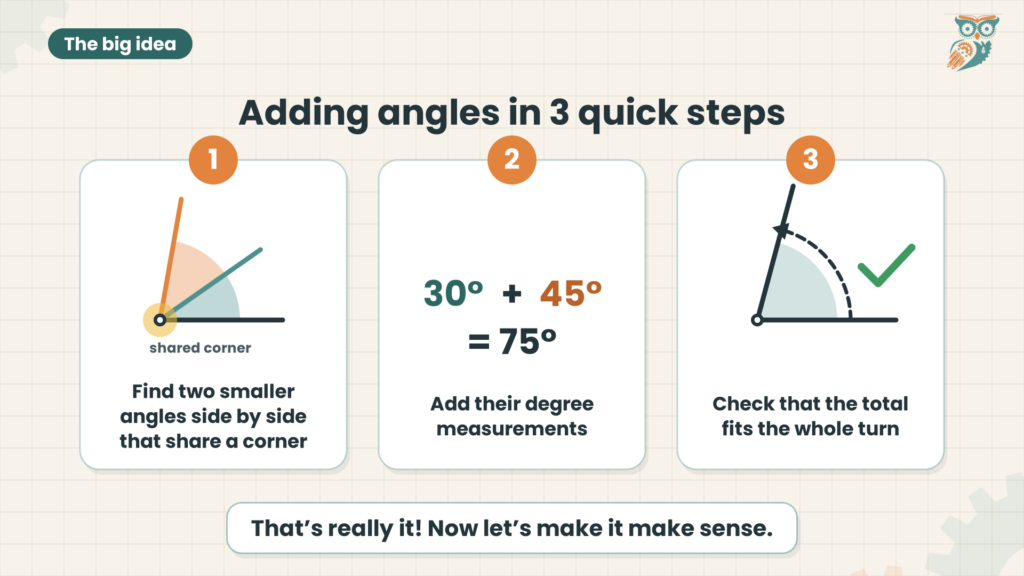
Just like adding two smaller lengths to find a total length, we’re adding two smaller angle measurements to find the whole angle.
How Smaller Angles Add Up to a Larger Angle
Just like two shorter distances can be added together to find the total distance, two smaller angles can be combined to find the measurement of a larger angle.
For example, imagine turning 145 degrees to the right, then continuing another 65 degrees in the same direction.
145° + 65° = 210°
You’ve made one larger turn measuring 210 degrees!
But wait, isn’t 180 degrees a straight angle? Can an angle really be greater than that?
Absolutely! Angles don’t stop at 180 degrees. If you continue turning beyond a half turn (180°), your angle keeps getting larger until you’ve completed a full 360-degree rotation.
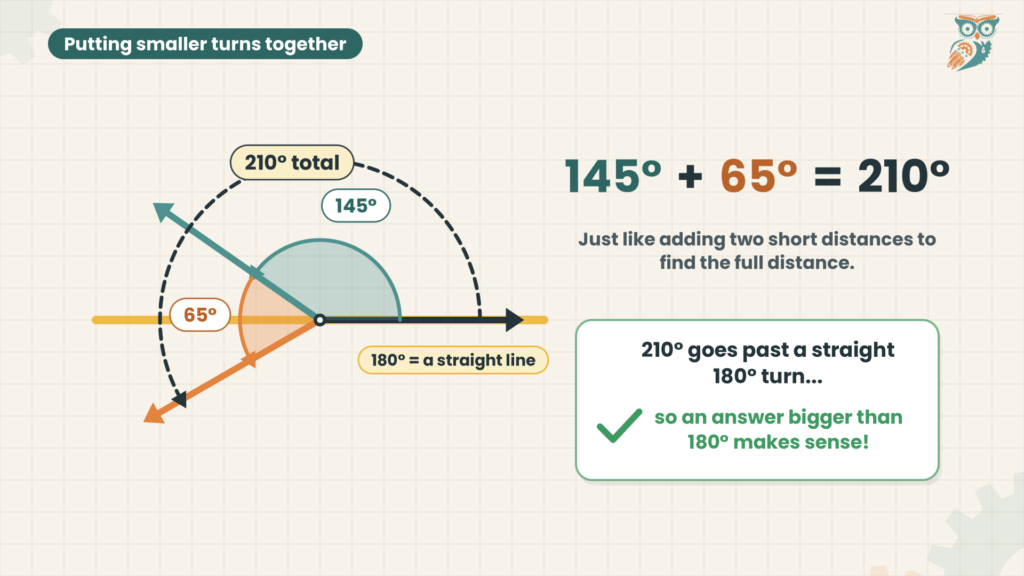
An angle measuring 210 degrees means you’ve turned just a little more than halfway around a circle. Angles greater than 180 degrees but less than 360 degrees are called reflex angles.
When adding angles, it helps to visualize how large the total angle should be. If the two smaller angles add up to more than 180 degrees, you know the combined angle will extend beyond a straight line.
The Short Way or the Long Way
We often assume an angle is the smaller space between two lines. Sometimes, however, the angle travels the longer way around.
The curved arc in the picture tells your child which turn to use.
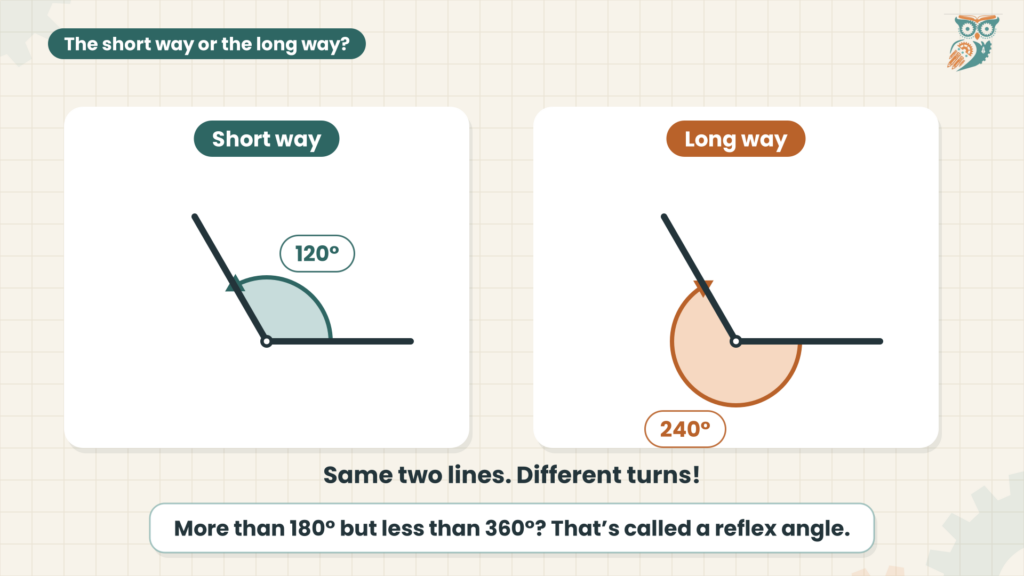
Before doing any addition, have your child trace that curved arc with a finger and ask:
- Where does the turn begin?
- Where does it end?
- Does it travel the short way or the long way around?
- Does it stop before 90 degrees, go beyond a straight 180-degree turn, or travel most of the way around a complete 360-degree turn?
The goal is not to guess the exact answer from the picture. This quick look simply gives your child a general sense of what the answer should be, so they can recognize when a calculation does, or does not, make sense.
Curious about the math name? An angle that measures more than 180 degrees but less than 360 degrees is called a reflex angle. Your child does not need to remember that name in order to understand or play the game.
Practice Adding Angle Measurements with a Digital Math Game
The Add Angle Measurements game below, gives children 20 illustrated angle problems to solve. In each one, a larger turn has been divided into two smaller turns, and children add the two measurements to find the size of the complete turn.
After solving each problem, children enter their answer and select Check. They find out right away whether the answer is correct, so they can move ahead or take another look while the problem is still fresh in their minds.
The game includes turns of many different sizes. Some are smaller than a quarter turn, some travel more than halfway around, and others cover most of a complete turn. This variety helps children understand that an angle can describe any amount of turning, not only the small angles they often see on worksheets.
Try the Add Angle Measurements Game Here:
How to Play the Add Angle Measurements Game
- Look at the two given angle measurements.
- Trace the curved mark to see the complete turn.
- Decide whether the whole turn is less than or more than halfway around.
- Add the two measurements.
- Enter the total in the answer box.
- Select the blue Check button.
- If the answer is incorrect, compare it with the picture and try again.
- Move to the next card and continue until all 20 problems are complete.
Give Me a Hint
There are a few built-in hints, and we encourage students to take a peek at the hints to see if they can “unstick” themselves. Often these prompts and reminders are enough to support them in moving forward:
- Where does the turn begin?
- Where does it end?
- Which two smaller turns make up the whole turn?
- Is the total less than 90 degrees, between 90 and 180 degrees, or greater than 180 degrees?
- Does the answer you calculated fit the turn shown in the picture?
This keeps angle work from becoming another rule to memorize. Students begin to understand that the numbers describe real movement, and that they can use the picture and their own reasoning to check the math.
If Your Child Gets Stuck and Can’t Move On
If the built-in hints aren’t enough, rest assured, you do not need to reteach the lesson or explain everything yourself. Begin by asking your child to show you the turn, and ask one question at a time:
- “Can you trace the whole turn?”
- “Which two smaller turns make it?”
- “Is it more or less than a half turn?”
- “What two numbers do you need to add?”
- “Does your answer fit the picture?”
If the diagram of the angle travels more than halfway around but the answer is only 85 degrees, something does not match. Your child can check the addition or take another look at which turn the curved mark is showing.
The goal is not simply to get the answer correct. It is to help your child notice when an answer makes sense, and when it deserves another look.
Grab the Printable Recording Pages
Pair the game with the Add Angle Measurements printable Recording Pages. As children play, they can record the two given measurements, show their addition and write the measurement of the complete angle.
Recording the work on paper slows the process down just enough for students to notice the relationship between the smaller angles and the whole. It also gives parents and teachers a way to see whether a mistake came from the addition or from interpreting the diagram.
Try It Away from the Screen
Angles make more sense when children can connect them to actual movement. Have your child create or find an angle and decide whether it is closest to 90, 180, 270 or 360 degrees.
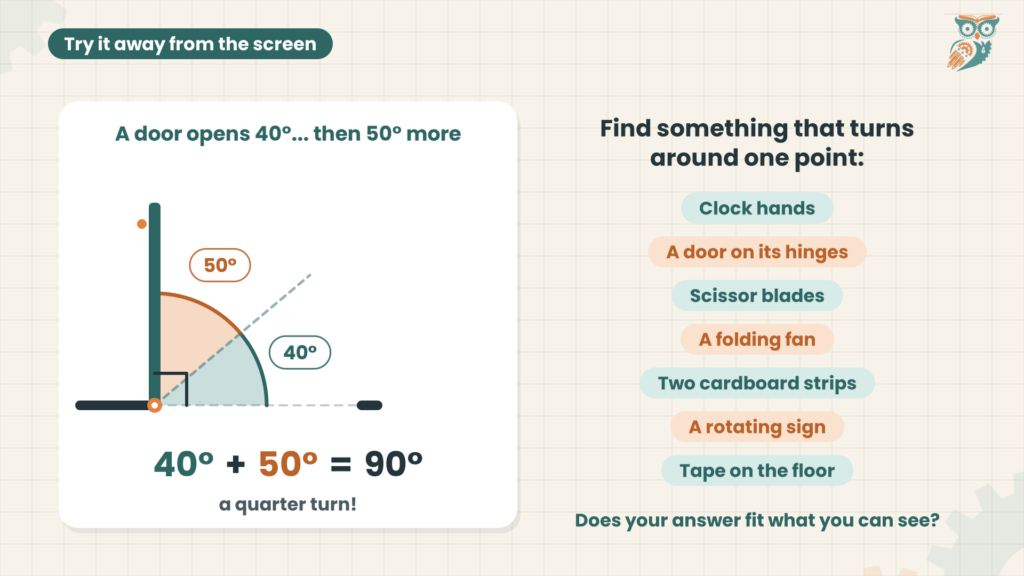
Next, divide the total turn into two parts. For example, a door might first open approximately 40 degrees and then move another 50 degrees.
Choose something that turns around a fixed point, such as:
- The hands of an analog clock
- A door opening on its hinges
- Two strips of cardboard fastened together
- The blades of scissors
- A folding fan
- A rotating sign or pointer
- Two pieces of tape meeting at one point on the floor
Ask:
- How far did the door turn altogether?
- What operation will help you find the total?
- Does your answer fit what you can see?
Want to Add the Angle Names?
- Acute: less than 90 degrees
- Right: exactly 90 degrees (the square corner you’ll also find in our hands-on Pythagorean theorem activity)
- Obtuse: more than 90 degrees but less than 180 degrees
- Straight: exactly 180 degrees
- Reflex: more than 180 degrees but less than 360 degrees
If you have a protractor, students can measure the two parts and then compare their calculated total with the measurement of the complete angle.
Where We Use Angle Addition
Angle addition matters whenever separate turns or sections come together to make a larger one. A builder may need to determine how two sections of a roof meet. A game designer plans how far a character or object will turn. Artists use angles to create patterns and perspective, and you can see this in action with tessellation art, where the angles meeting at each corner have to add up to exactly 360 degrees. Athletes and navigators use angles to think about direction, too.
Children are practicing more than addition when they play this game. They are learning to interpret a diagram, visualize an amount of turn and determine whether a mathematical answer is reasonable.
Ready to Add Angles Together?
You do not need to deliver a formal math lesson or have every answer before you begin. Open the game, try the first few problems together and use the questions in this post whenever your child needs help. The game provides the practice and feedback while you help your child notice the turn and decide whether the answer makes sense. When your child is ready for more, there’s a game called Measuring Angles inside Digital Math Games that’s worth a try, or browse more of our hands-on math activities.
Make Math Practice Feel Like Play!
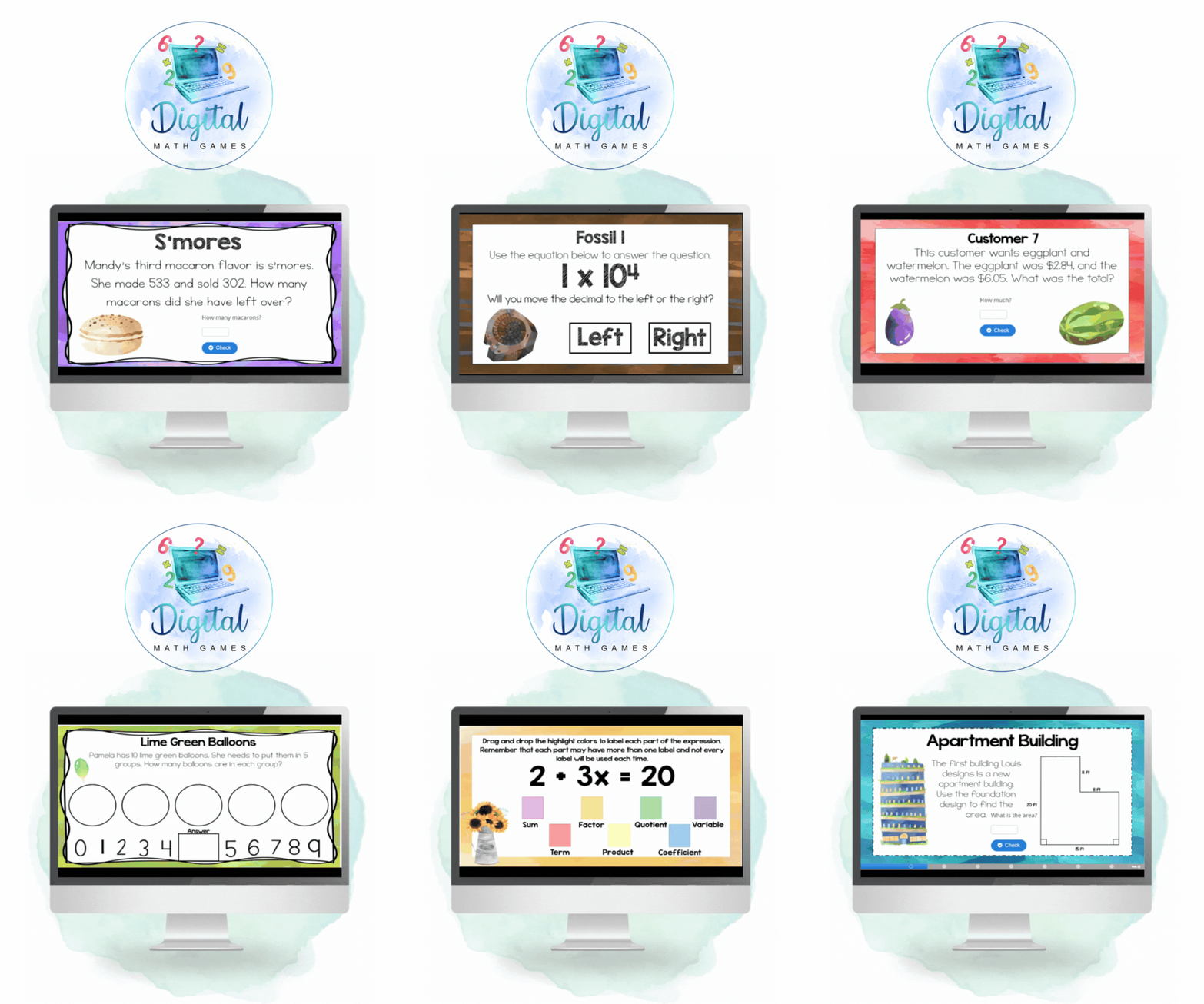
Looking for more ways to practice math skills? Digital Math Games has self-checking games for every grade, skill, and Common Core standard. Each game also includes a printable recording page, so kids can play in the browser while you see their thinking on paper.
Try Digital Math Games for FREE and start playing today!
Common Core Learning Connection
This activity supports Common Core Math Standard 4.MD.C.7, which asks students to recognize angle measure as additive and solve addition and subtraction problems involving unknown angles. It also develops mathematical practices including:
- Making sense of problems
- Reasoning with quantities
- Using tools strategically
- Attending to precision
- Checking whether an answer is reasonable
Frequently Asked Questions
Adding angle measurements is usually taught in 4th grade. In the Common Core standards, students first learn that angles are measured in degrees and practice measuring them with a protractor (4.MD.C.5 and 4.MD.C.6), then learn that angle measures can be added together (4.MD.C.7). Many children are ready to explore the “angles as turns” idea earlier, especially with clocks and body turns.
Use subtraction. If the whole turn is 120° and one part is 45°, subtract to find the other part: 120° − 45° = 75°. It is the same relationship as adding angles, just working backward.
To combine two angles into one larger angle, they need to share the same corner point (the vertex) and sit side by side without overlapping. You can always add two angle measurements as numbers, but they only form one bigger turn when they connect this way. This is why tracing the arc in each picture is so helpful.
Yes. Most protractors only show 0 to 180 degrees, but turns can be much larger. For a reflex angle, measure the two smaller parts and add them, or measure the smaller angle on the other side and subtract it from 360 degrees. Both methods should give the same answer, which makes a great self-check.
The angle addition postulate is the formal geometry name for the idea in this post. It says that if a point lies inside an angle, the two smaller angles it creates add up to the measure of the whole angle. Students usually see this name in middle school or high school geometry, but it is the same “small turns make a bigger turn” idea your child is practicing now.